CONDITIONING 101: (8 Weeks to Super Fit)

By TAKU
No matter what sport you engage in from Golf to Ice Hockey, American Football to international Futbol (that’s soccer to all you Americans)…all athletes will benefit from a simple solid conditioning program. In fact, even if you are not currently practicing any sport in particular, a simple conditioning plan will benefit everyone when it comes to total fitness.
Most folks who have been reading my work for a while know that I am a proponent of interval style training programs. I know that interval training has become cool of late, but I have actually been recommending brief intense conditioning plans since the late 1980’s.
Interval training plans for sports are often designed with specific distances such as sprint for 60 meters, recover for a specified time, and repeat. Rather than use distance as a goal, I prefer to use time. Using time instead of distance will help people of varied fitness levels and body types stay within the desired range. If you are a 300-lb. Offensive lineman playing American Football, running 100 meters may take you a little longer than it would a 160 lb. striker playing World Futbol. By using specific times (instead of distance) we can insure similar energy systems being activated and keep the work consistent. for everyone. Finally using time instead of distance allows us to choose from a broad array of training tools or modes both indoors and out.
Most athletes will utilize a wide variety of energy systems along the intensity continuum. Remember this is a general conditioning program. It will help build a base of conditioning for almost any activity. Participants playing such sports as American Football, Basketball, Field Hockey, Rugby, Lacrosse etc. may all benefit from this type of program, especially in the off-season.
Once you are nearing the pre-season or are in-season, the playing and practicing of your specific sport should take precedence. Practicing specific sports will always be the best way to prepare for those specific activities. For instance someone training for pure speed such as a 100 meter sprint specialist, will first and foremost want to polish technique and running mechanics. The actual practice of sprinting is designed to be an all-out 100% maximum effort. To prepare for running at full speed, one must practice running at full speed. To allow this to occur maximum recovery between bouts will be required.
Below I have outlined an 8-WEEK Conditioning Program. It is set up with specific work to rest ratios. Each week we will increase the volume of sprints while reducing the actual exertion times. Your goal is to go at the most brisk pace you can tolerate, and still maintain work for the desired time. As you progress through the program (and your conditioning improves) you should be striving to go as fast and as hard as possible during the work phase of each bout of intervals. During the recovery period just walk (or pedal etc.) very slowly while you catch your breath and prepare for the next work phase.

If you are an open field athlete I highly recommend that you do your best to perform this workout on a running track or sports field.
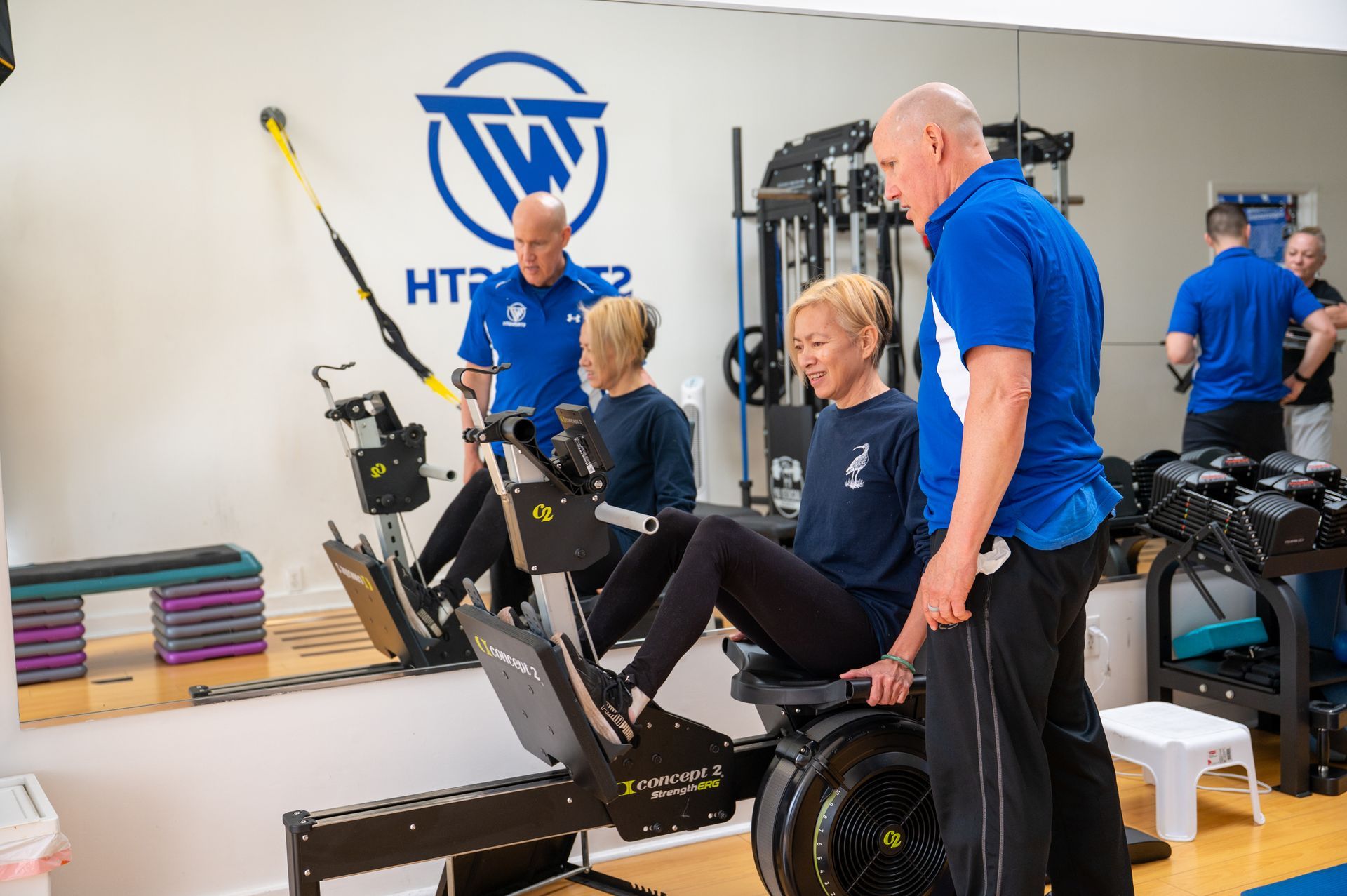
For general fitness enthusiasts, any tool of choice may be used. Recommended tools include but are not limited to:

Air-Bicycle Rowing Ergo-meter Step-Climber Elliptical Cross-Trainer Versa-climber Jump-Rope

8-WEEK CONDITIONING PROGRAM
In this program I recommend that you perform the conditioning program on two, non-consecutive days in your training week such as Monday and Thursday. You may do strength and conditioning on the same day, or you may separate them. Here are two examples of ways one might combine these types of training in an overall S&C plan:

EXAMPLE 1: (For those with better recovery ability)
EXAMPLE 2: (For those who require more recovery)
Monday: Conditioning Tuesday: REST Wednesday: Strength Training Thursday: REST Friday: Conditioning
Saturday / Sunday: REST
Monday: Strength Training Tuesday: REST Wednesday: Conditioning Thursday: REST Friday: Strength Training
Wash – Rinse – Repeat
Week 1
Day 1 – 1 x 2:00 / 4:00 & 2 x 1:00 / 2:00
Day 2 – 2 x 2:00 / 4:00 & 3 x 1:00 / 2:00
Week 2
Day 1 – & 2
6 x 00:20 / 01:00
Week 3
Day – 1 & 2
4 x 00:36 / 01:48
3-5 minutes rest
8 x 00:18 / 00:54
Week 4
Day – 1 & 2
4 x 00:36 / 01:48
3-5 minutes rest
8 x 00:18 / 00:54
Day – 1 & 2
4 x 00:34 / 01:42
3-5 minutes rest
8 x 00:16 / 00:48
Day – 1 & 2
4 x 00:32 / 01:36
3-5 minutes rest
8 x 00:15 / 00:42
3-5 minutes rest
6 x 00:07 / 00:21
Day – 1 & 2
4 x 00:30 / 01:30
3-5 minutes rest
8 x 00:14 / 00:42
3-5 minutes rest
6 x 00:07 / 00:21
Day – 1 & 2
4 x 00:30 / 01:30
3-5 minutes rest
8 x 00:14 / 00:42
3-5 minutes rest
6 x 00:07 / 00:21
TAKU's NOTE: My personal S&C program is very similar to that shown in Training week example # 2. above.
Experience the TNT Strength difference with a free workout.
START YOUR FITNESS TRANSFORMATION WITH A
FREE WORKOUT
Complete the form and we'll set up an appointment for you.
Recent Articles